All the recipes

No. 09MalaysianChickenCurry

Rendang Ayam

The benchmark is a chicken rendang on a Singapore Airlines flight. It beat every rendang I ate in Malaysia. Those were wetter, milder, less spiced. This is the one to beat it.

John Drummond

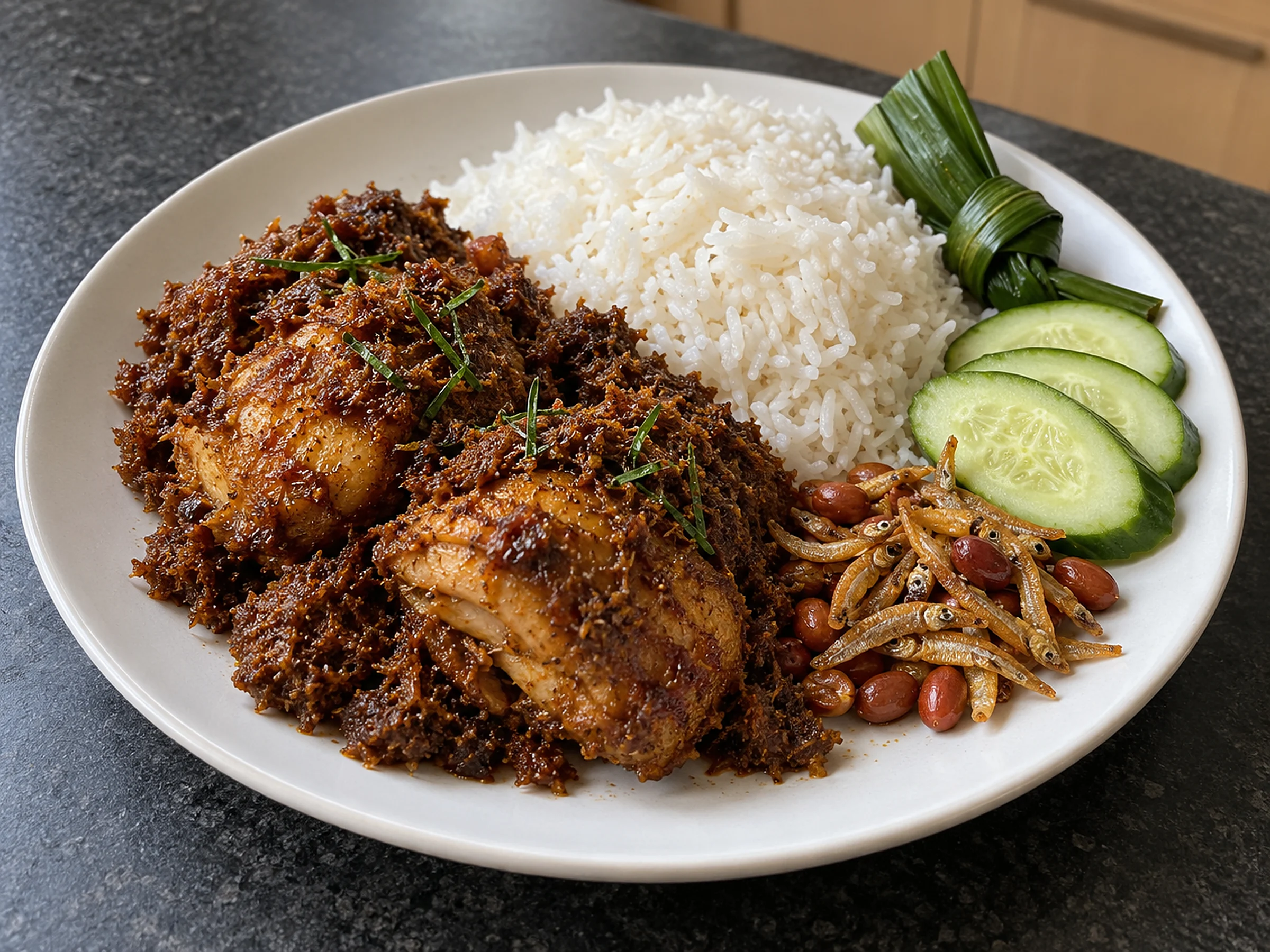
Chicken thighs thickly coated in dark, granular rendang on a white plate beside a mound of white rice and a knotted pandan leaf, with sliced cucumber and a pile of fried peanuts and small crisp anchovies, on a charcoal benchtop
Prep1hr
Cook2hr
All up

3hr+ 12–24 hours

Serves4
LevelHard

Mise en place

What you need

Tick each one off as it goes in.

The chicken

Coconut and kerisik

Rempah one: the dark base

Rempah two: the aromatics

To cook

To serve

If you can't press coconut

Makes 4 serves

Rendang isn't a curry. It's a coconut braise cooked down until the oil splits out and the paste fries again in its own fat, dark and sticky, clinging to the meat. Most chicken rendangs stop one stage early and you get a nice coconut curry. Here's what it came down to: - Two pastes, not one. The shallot, garlic and chilli need a long fry to go sweet and dark. The galangal, lemongrass and turmeric go tired and woody if they sit through all of it. So the dark base goes in first and the aromatics after. - Judge the paste on a white plate, not by the clock. Fresh turmeric stains it orange and makes a half-cooked paste look done. Smear a little: it's ready when it's dark brick right through with no yellow middle. - Fresh coconut milk, pressed from frozen grated coconut. The thick first press gets fried with the paste until the oil splits again and the paste turns brown. The thin second press braises the chicken. The same coconut, toasted, makes the kerisik. Two good cans are the fallback. - Kerisik toasted to chestnut, not further, and stirred in late. Darker than chestnut is one step from bitter. - Bone-in thighs, salted overnight, slashed and packed with the fried paste, pulled one at a time by probe, then left overnight in the sauce. The next day they're fried once, until the sauce sizzles and the oil beads on the meat. That's the rendang. - Turmeric leaf (daun kunyit) is the smell of it. Ring around for it. Makrut lime leaf is not a stand-in; it's a different dish.

It's a three-day job with not much work on the first and last days. Day one, salt the chicken. Day two, cook it, about two and a half hours at the stove. Day three, fry it and eat it.

This one's tricky, so there's a section at the bottom on how to save it when it goes wrong.

Where to get things in Adelaide. Ring before you drive; none of this is a promise of stock. - Adelaide's Finest, Frewville (177 Glen Osmond Road) and Pasadena (20 Fiveash Drive). They list frozen galangal, frozen turmeric root, frozen lime leaves, lemongrass and frozen grated coconut. Not their "Tamarind With Sugar" (it's sweetened), and their palm sugar isn't gula melaka. - Bakulan, 594 Goodwood Road, Daw Park. Indonesian grocer; lists frozen galangal. Ask for kemiri (candlenut), asam jawa (tamarind), gula jawa (palm sugar), ikan teri (dried anchovy) and frozen daun kunyit. - Homes Supermarket, 110 Gouger Street in the city, 400 Churchill Road Kilburn, 191 Glynburn Road Firle. Malaysian and Singaporean groceries: the first call for gula melaka, tamarind block, candlenuts, dried long chillies and ikan bilis. - Thuan Phat, Days Road, Croydon Park; Asian Grocery, 162 Henley Beach Road, Torrensville; JL Choice Mart, Wright Court in the city; Asian Green Grocer, Central Market. All worth a call for turmeric leaf and the dry goods. - No shop in Adelaide lists turmeric leaf online. Ask for frozen daun kunyit by name. Dried is hay.

It hasn't been made in this exact form yet. The step photographs are AI-generated, made to look like my kitchen, to show what each stage should look like; they aren't photos of me cooking it.

AI reviewed by Grok, Codex & Claude
The method

Fourteen moves.

  1. Chicken, Salt

    The day before you cook. Two slashes to the bone on the meaty side of each thigh. 11 g salt all over and into the cuts. Covered, in the fridge, 12–24 hours.

  2. Coconut, Press

    Take 100 g of the grated coconut for the kerisik. Knead the rest with 350 ml of the warm water, 2 minutes, and squeeze hard through a muslin or a clean tea towel. That's the first press, thick, about 320 g. Knead the pulp again with the other 250 ml and squeeze: the thin second press. Keep them apart. Canned: scoop the thick cream off the top of the two chilled cans (about 200 ml) for the first press; the thin milk underneath is the second.

  3. Kerisik, Toast

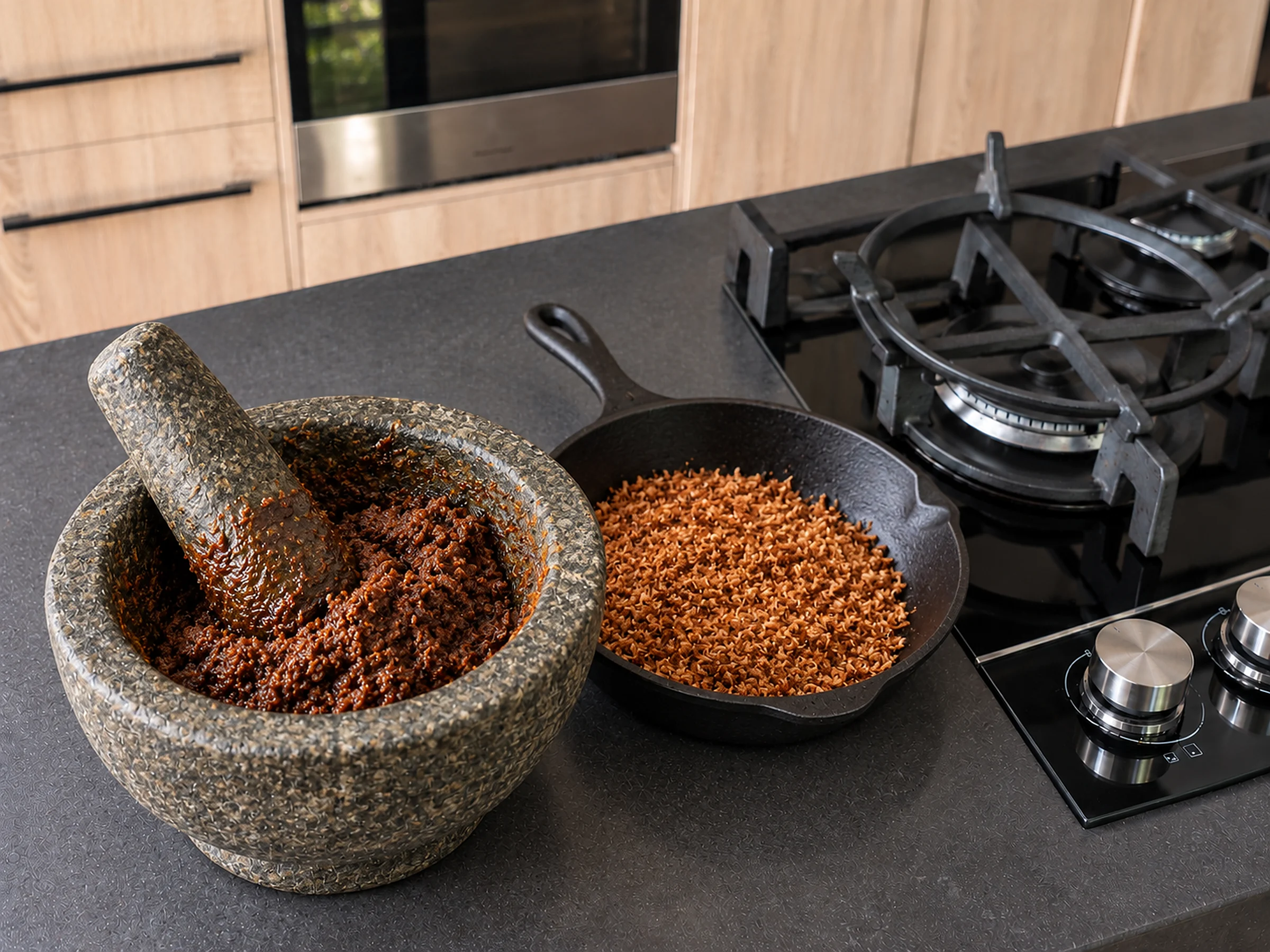
    The 100 g coconut (or 70 g desiccated) in a dry pan, medium-low. Keep it moving once it colours, 18–25 minutes for fresh, 8–12 for desiccated. Stop at an even deep chestnut: no pale bits, no black. It smells of toasted hazelnut. Tip it straight into a mortar or a spice grinder and grind while it's warm until it's an oily paste that holds when you pinch it. You want 55 g.

    Dark chestnut ground toasted coconut paste in a stone mortar and pestle on a charcoal benchtop, a small cast-iron pan of toasted grated coconut beside it, next to a black glass gas cooktop
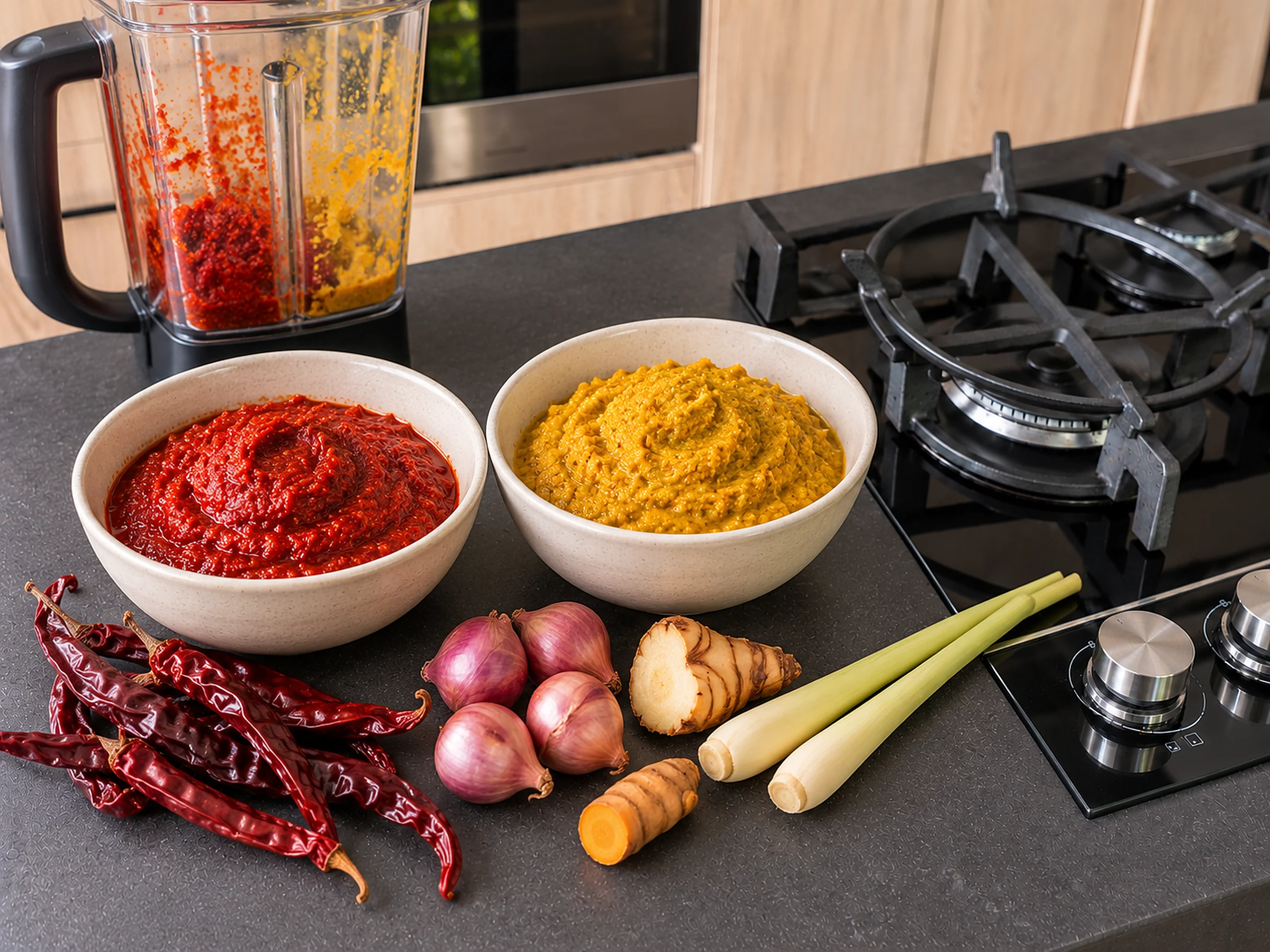
  4. Rempah, Blend

    Dried chillies in just-boiled water, 20 minutes. Don't boil them. Bite a piece. Mild: keep the seeds. Moderate: shake out half. Hot: shake out all of them. Toast the coriander and cumin until they smell, then grind.

    Blend the dark base (shallots, garlic, both chillies) very fine with a spoon of the first press. Then the aromatics (galangal, ginger, turmeric, sliced lemongrass bases, candlenuts, ground spices, white pepper), with a spoon of first press, until there are no threads. Two bowls. No water.

    Two bowls of fine paste, one deep red, one yellow-orange, on a charcoal benchtop with dried red chillies, Asian shallots, galangal, fresh turmeric and lemongrass, a blender jug behind
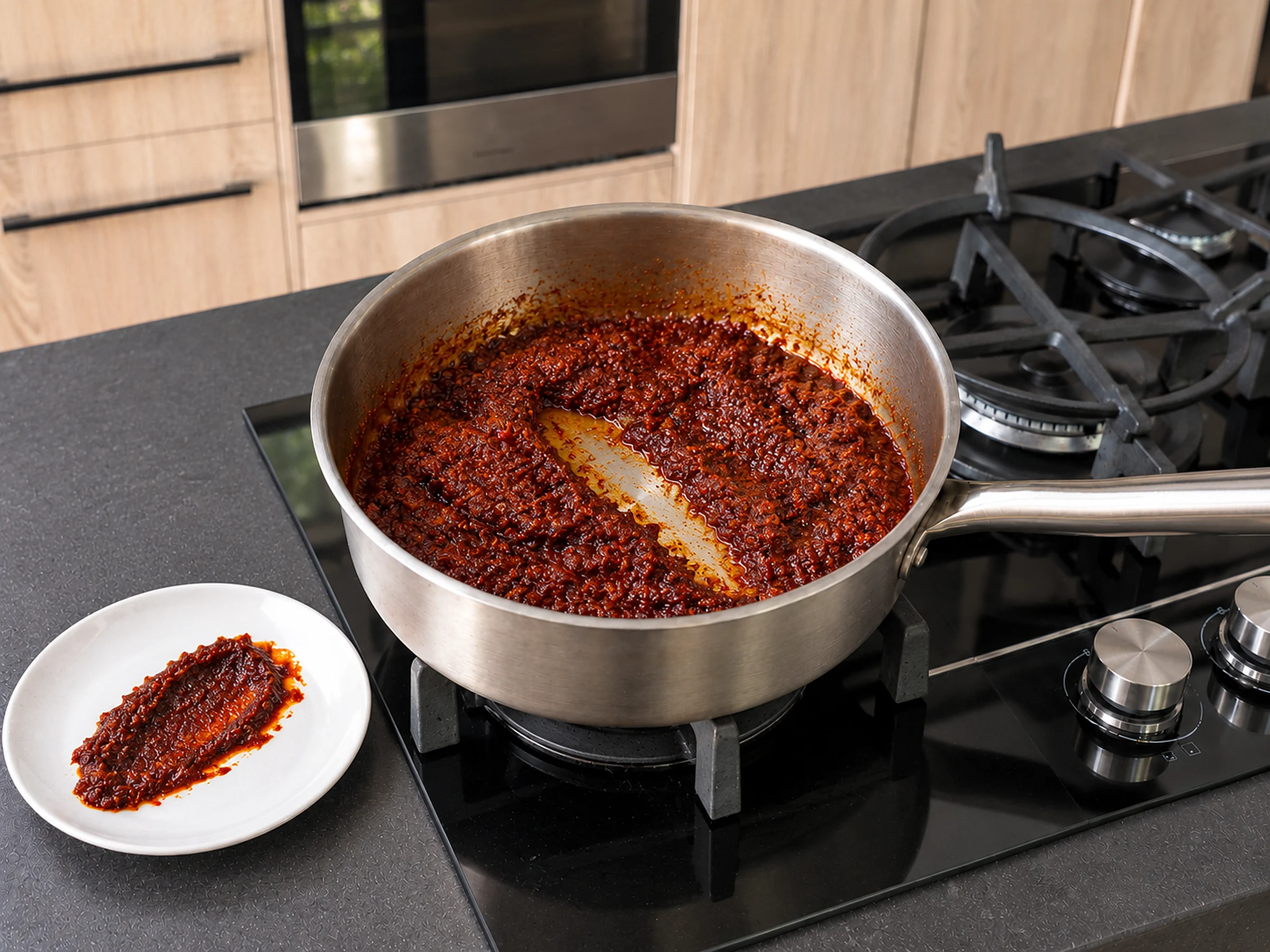
  5. Base, Fry

    Wide stainless pan, 30 cm or more. The oil, medium. The dark base in. It spits, goes foamy and crimson, then brick, then dark brick and sticky. 18–25 minutes, stirring more as it dries. Smear a little on a white plate: dark brick all through, no pink middle. Push a spoon through; the channel stays open a second or two. A spoon of thin press if it catches early.

    Thick, dark brick-red fried paste in a stainless sauté pan on a black glass gas cooktop, a channel pushed through it, with a smear of the paste on a small white plate beside the pan
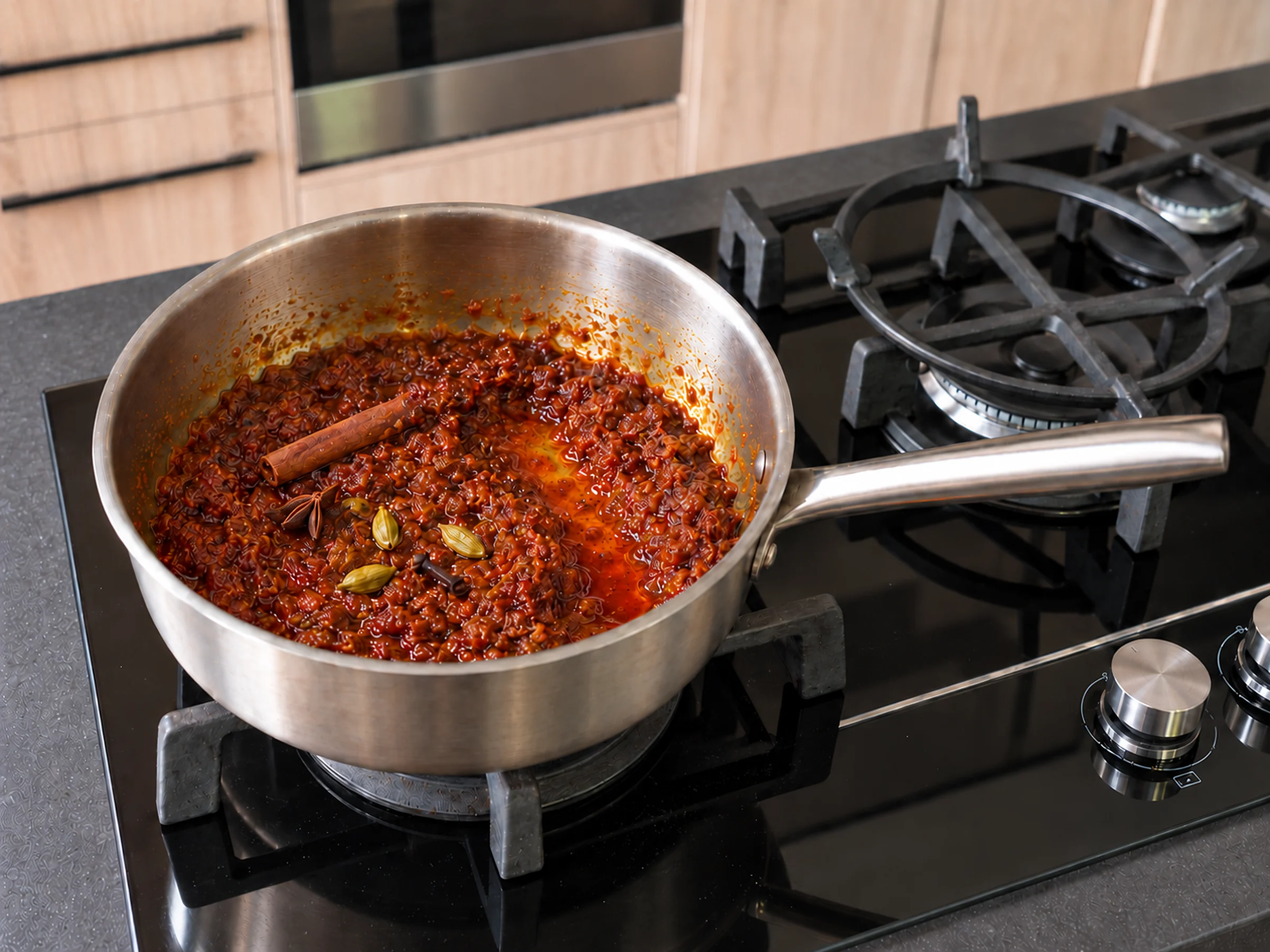
  6. Aromatics, Fry

    The second paste in. It goes wet and orange again; that's right. 12–16 minutes, until there's no raw lemongrass or turmeric smell, it's dark red-brown again and red oil sits in a channel that stays open three seconds. The cinnamon, star anise, cardamom and clove for the last 90 seconds.

    Dark red-brown fried paste with red oil pooling in a channel, a cinnamon stick, cardamom pods and a clove on top, in a stainless sauté pan
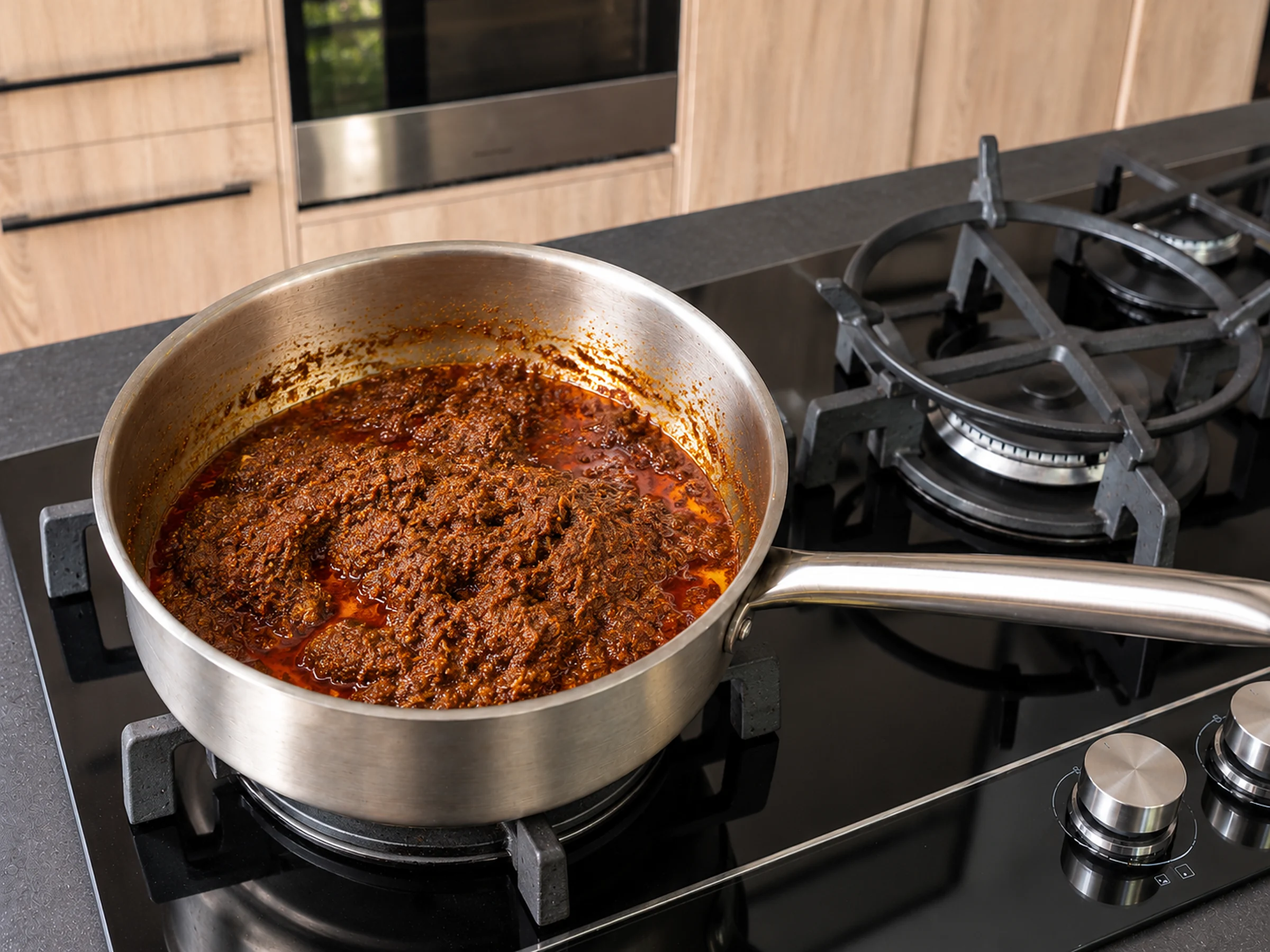
  7. Cream, Split

    The first press in, all but a spoon. Medium-low, stirring. It bubbles white, then the oil splits out red. Keep going, 8–15 minutes, until the paste turns from red to brown and a pinch smells of palm sugar, not fried chilli. The moment that sweet smell turns sharp, a spoon of thin press and move on.

    Brown, granular fried paste with orange-red oil separated around the edges, in a stainless sauté pan on a black glass cooktop
  8. Chicken, Braise

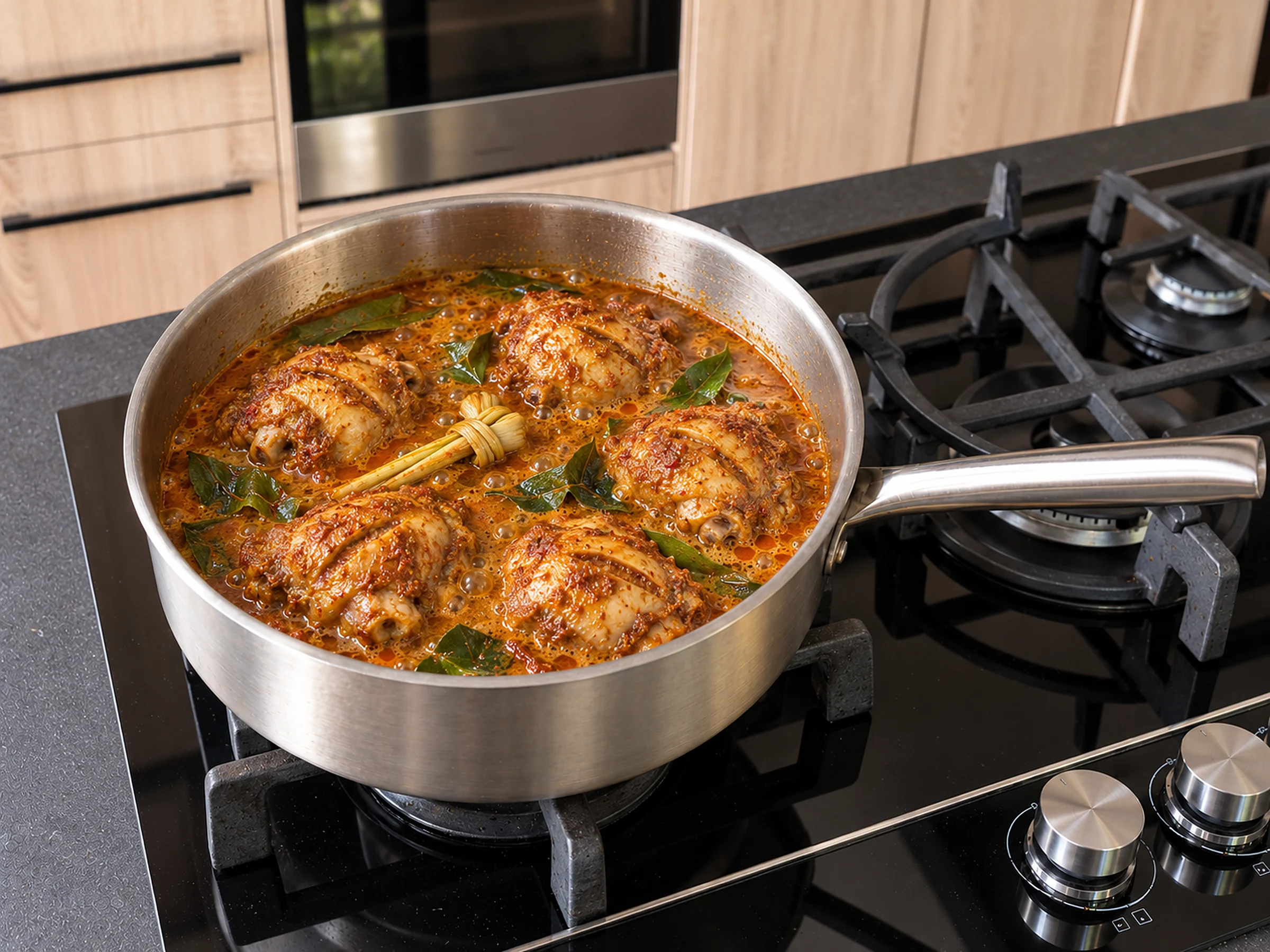
    A teaspoon of the fried paste into each slash. Thighs in, turn them 2 minutes. 180 ml of the thin press (keep 60 ml), half the tamarind water, 6 g gula melaka, 8 g turmeric leaf torn up, 4 lime leaves bruised, the lemongrass tops knotted. Gentle simmer, lid half on. Probe from 18 minutes, the thickest meat, not touching bone. Each thigh out at 76–78°C. Don't wait for the slowest one. Fish out the leaves, tops and whole spices.

    Six slashed chicken thighs simmering in an orange-brown coconut sauce with torn turmeric leaf, lime leaves and a knotted lemongrass top, in a stainless sauté pan
  9. Sauce, Reduce

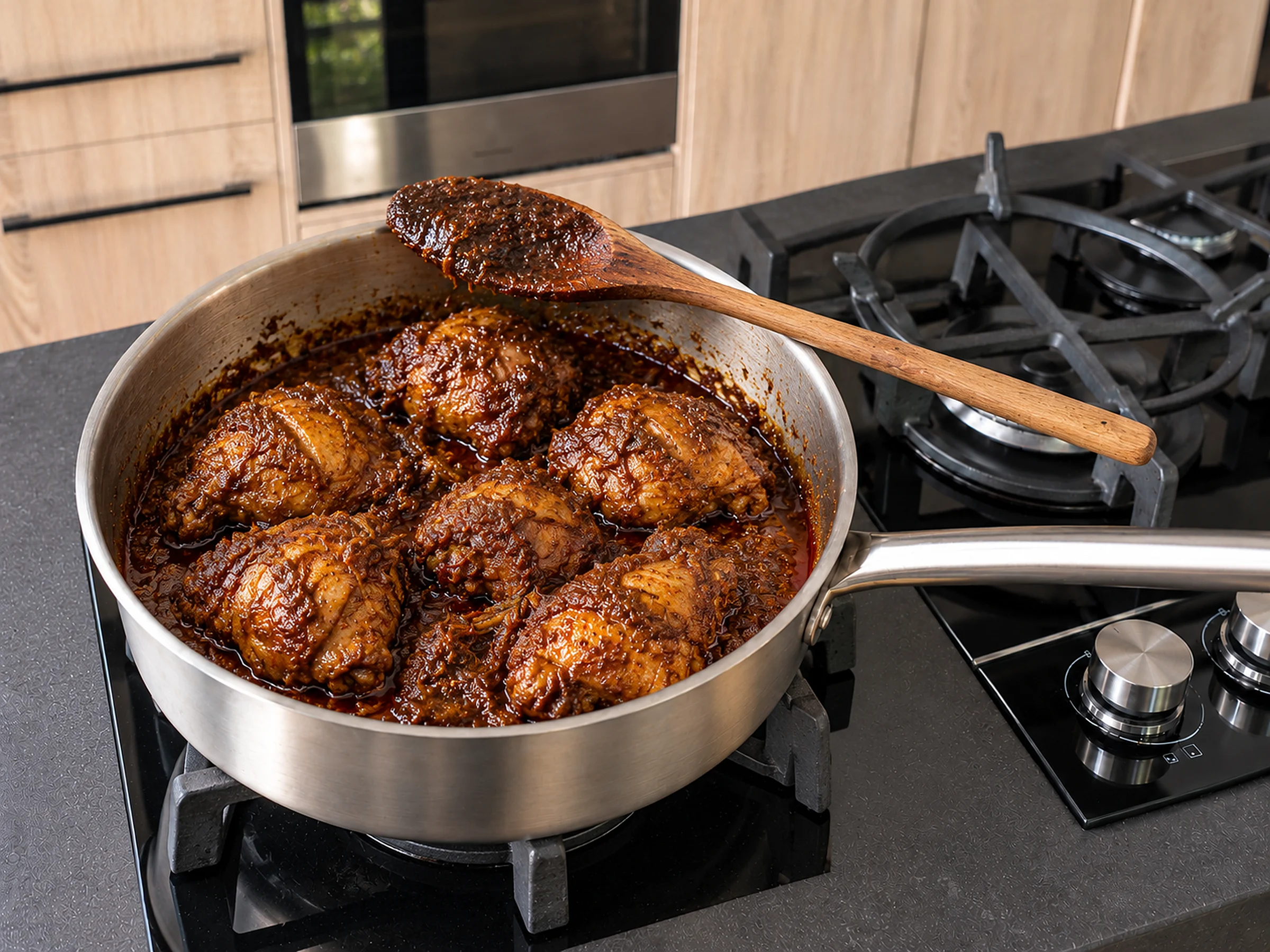
    Lid off, medium-low, stirring. When oil shows, the kerisik, 2 g salt and the other 6 g gula melaka. Stop when it coats a spoon and a line through it closes in about a second. Glossy, not sizzling, not dry. Thighs back in, turned through.

    A wooden spoon across the pan, its back coated in thick, glossy dark brown rendang sauce, over chicken thighs in the reduced sauce
  10. Rendang, Rest

    Into a tray no deeper than 4 cm. Hold back 2 tablespoons of sauce in a cup. Cool fast, from 60°C to 21°C within 2 hours and to 5°C within 4. Fridge overnight. Up to 3 days.

  11. Rice, Cook

    Rinse the rice until the water's nearly clear, drain 15 minutes. Coconut milk, water, salt, pandan. Rice cooker, then 10 minutes unopened. Cucumber sliced cold. Peanuts fried at 150°C until golden; ikan bilis fried separately at 160°C to pale gold. Drain. They meet on the plate.

  12. Rendang, Fry

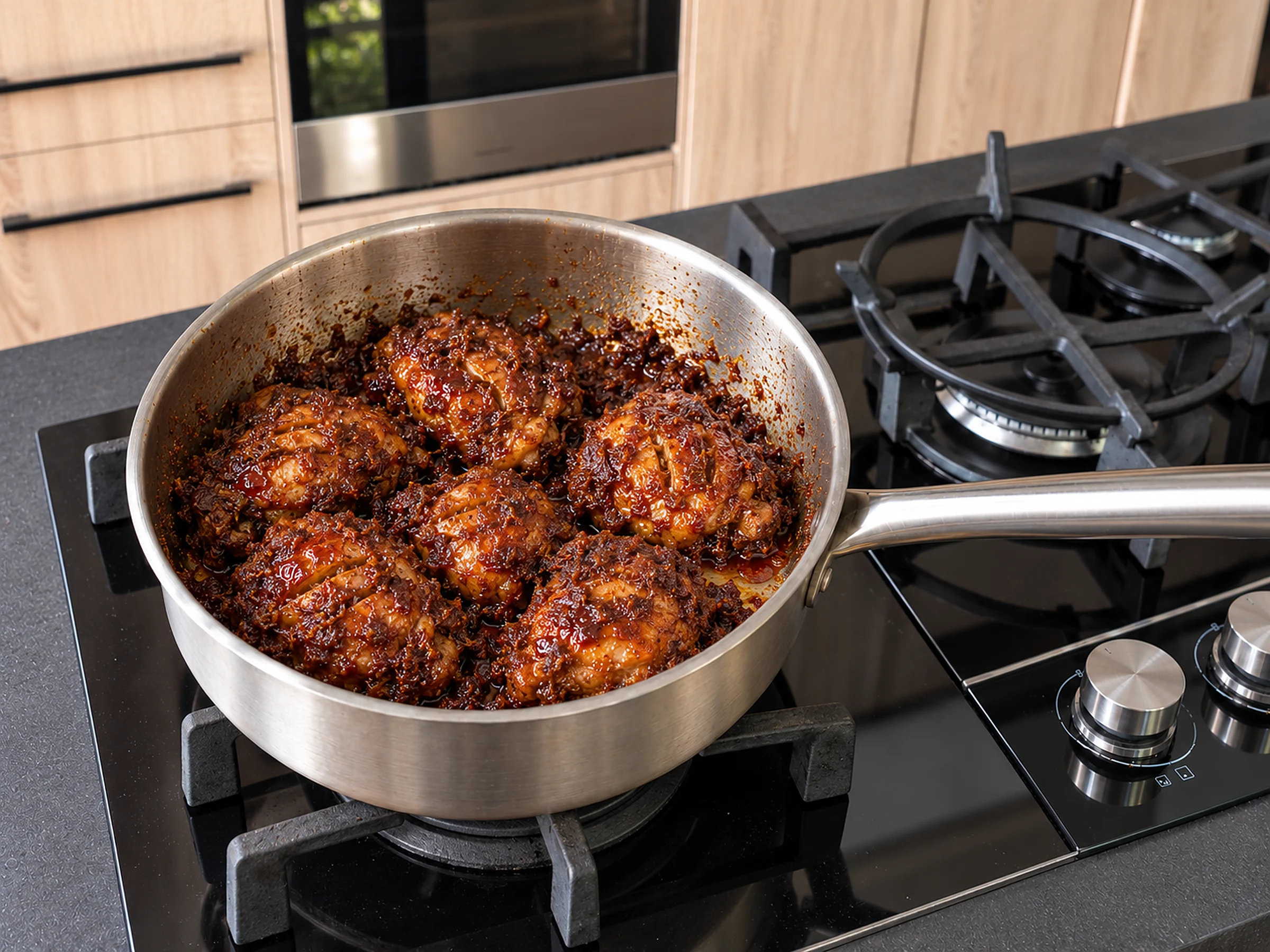
    Next day. A spoon or two of the thin press if it's stiff. Heat until every piece is 75°C. Then medium, one layer, two batches if they overlap, turning, 4–6 minutes. The bubble turns into a sizzle, oil beads on the meat, a spatula shows the pan for three seconds. Stop. Off the heat, turn the thighs through the 2 tablespoons of held sauce so the coat goes glossy again.

    Chicken thighs thickly coated in dark mahogany rendang paste, red oil beading around them, in a stainless sauté pan on a black glass cooktop
  13. Leaves, Finish

    3 g turmeric leaf and 1 lime leaf, ribs cut out, sliced hair-fine. Fold through, 30 seconds. Taste. Salt in pinches first. Then the held tamarind, a little at a time, only if it tastes sweet and milky. Then 1 g MSG, only if it's still hollow.

  14. Plate, Up

    Rice, a thigh or two, cucumber, peanuts and ikan bilis. No sambal the first time; taste the rendang. Contains candlenut (or macadamia), peanuts and fish (ikan bilis); keep the peanuts and ikan bilis apart if anyone can't eat one. Candlenuts must be cooked; the fry does it. Read the tamarind label for gluten and sugar.

If it goes wrong

How to save it

The paste sticks, a few brown bits, still smells sweet
Heat's too high. Off the burner, a spoon of thin press, scrape, back on lower. Carry on.
Black flecks in the paste, a sharp, acrid smell
Scorched. Can't be saved; sugar only makes it bitter-sweet. Bin the paste and start again. The chicken can wait in the fridge.
The paste looks dark but smells of raw shallot or lemongrass, and a smear has a yellow middle
Under-fried. Keep frying. Don't add the coconut yet. If you already have, lift the chicken out and boil the sauce down until it fries again.
Kerisik with black grains, smelling of burnt popcorn
Can't be hidden. Before it's in: toast another batch. After it's in: lift the chicken out and make the sauce again. The bitterness won't come out.
Red oil pooling, fine bits of coconut, a sweet nutty smell and a frying sound
That's the split you want. Keep going. Don't try to bring it back together.
Pale grainy curds while it's still boiling hard
The heat was up before the water went. Turn it down and stir; if nothing's black, it'll come good as it reduces. Black solids: bin it.
Too wet: a lifted thigh drips and a line through the sauce closes at once
Chicken out. Reduce in the widest pan you've got, lid off. No cornflour, no extra kerisik to soak it up.
Too dry: matte, crumbly, dusty
It's gone past the lacquer. Off the heat, a tablespoon or two of hot thin press or coconut milk, then a short fry until it shines again.
A thin brown film sticking at the end, no bitter smell
Off the heat, a tablespoon of water, scrape, heat down, and stir from here on.
A black patch, smoke, a bitter smell at the end
Lift the unburnt sauce into a clean pan without scraping. If the bitterness came too, it's done: new sauce, same chicken.
A thigh under 75°C
Back into a looser sauce, lid on, low, until it's 75°C. Out again before you reduce. Never fry a raw middle in a dry paste.
Chicken stringy and dry
Can't be undone. Loosen the sauce and fold the meat through so the paste coats the torn faces. Pull at 76°C next time and keep the last fry short.
Too hot
A few spoons of coconut milk, then reduce again. More rice and cucumber on the plate. Sugar doesn't take heat out.
Too sweet
Salt in pinches, then a little tamarind. Not both in big doses, or it's a sweet-sour curry.
Too sour
A few grams of gula melaka, then salt. Harshly sour: a spoon of coconut milk, then reduce.
Flat
Salt first. Then tamarind. Then 1 g MSG. Never belacan, soy or kecap manis.
Too coconutty, sweet and milky
It hasn't fried long enough. Reduce until the oil beads, then a little tamarind.
Not dark enough
More frying in the split oil, chicken out. Not soy, not kecap. If the shallot base never got past orange, no finish will fix the taste; next time, the white plate.
Grassy or medicinal
Too much turmeric leaf, or the ribs went in. Pick out what you can see; a night's rest softens it. Weigh it next time.
Burnt ikan bilis
Bin that handful and fry a fresh one, on its own, to pale gold only.

Keep wandering

From the same volume.

Rendang Ayamserves 4 · 3 hr + 12–24 hours