All the recipes

No. 12FrenchChicken

Coq au Vin

this one will be my journey to make the best version in the world!

John Drummond

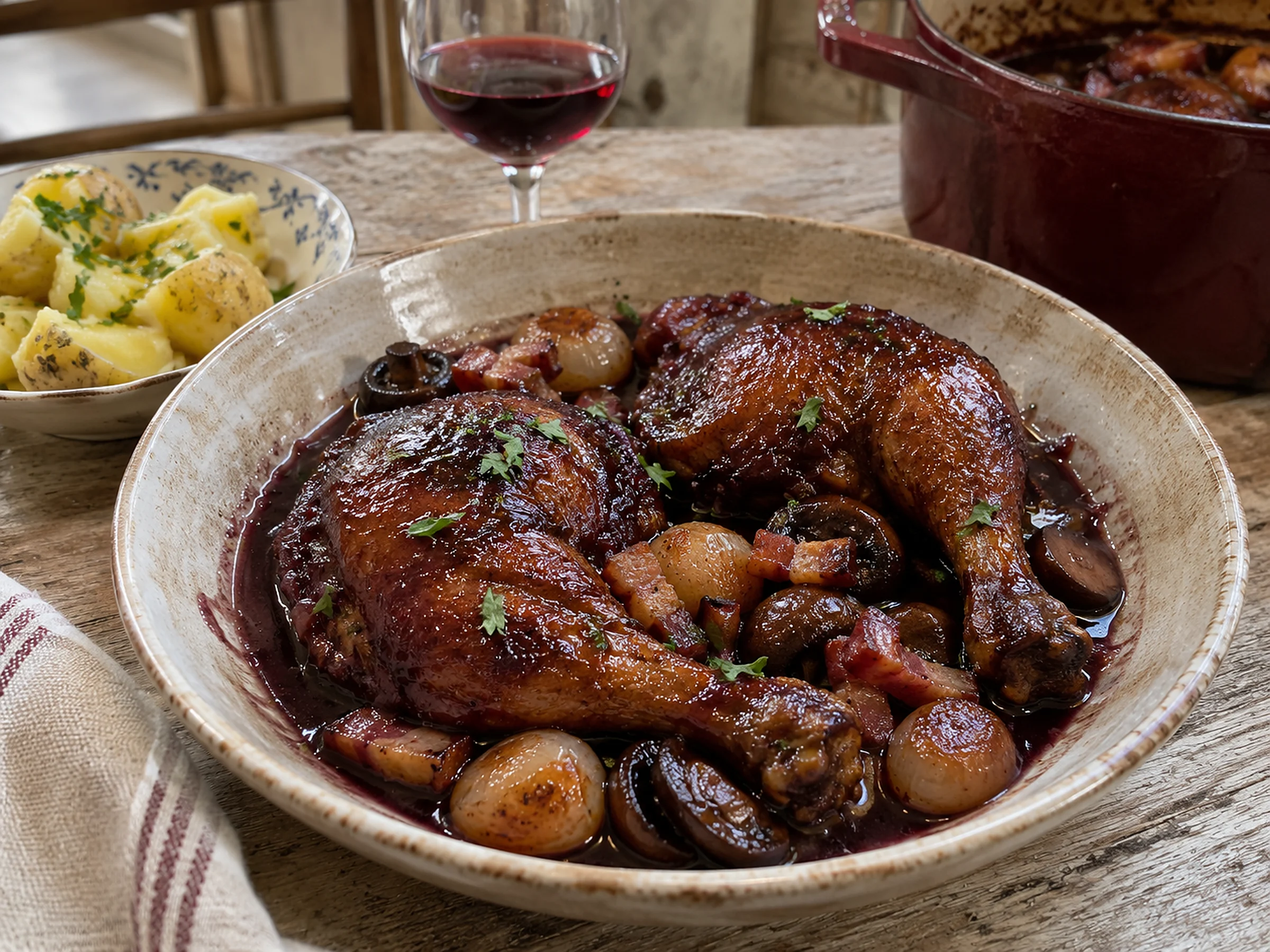
A speckled shallow bowl of coq au vin: two browned chicken marylands in a glossy dark red-wine sauce with whole glazed pickling onions, browned mushrooms and pork lardons, a little parsley, beside a bowl of crushed potatoes, a glass of Pinot Noir and a red enamelled casserole on a rustic timber table
Prep1hr
Cook4hr
All up

5hr+ 12–24 hours

Serves4
LevelHard

Mise en place

What you need

Tick each one off as it goes in.

The bird

The stock

The wine and the braise

The garnish and finish

To serve

Makes 4 serves

I've had coq au vin in France and it was fuck-balls amazing. Every attempt to recreate it in Australia has been good, but not fucking amazing. This one is my journey to make the best version in the world.

It went through the full AI competition: Claude, Grok, Codex and Gemini, four rounds, blind. The first job was working out why the French ones are better. All four agreed, and it comes down to four things, in the order you taste them.

The bird. In France it's often an older, slower-grown bird with dense, flavourful dark meat and plenty of collagen. Ours is a six-week supermarket chook, and its breast goes to cotton wool in a red-wine braise. So this is dark meat only, marylands, from the best bird you can get, salted overnight.

The sauce. The French one is wine reduced onto a real stock that sets like jelly. Ours is usually raw wine, carton stock and a pile of flour. So here the wine gets boiled down with shallot and thyme first, the stock is made from roasted wings and feet, and the flour is down to a teaspoon, only if it needs it.

The wine. Lots of Aussie reds taste of mint or gum leaf, and boiling makes it louder. Taste the bottle first.

The time. It sits overnight, the fat comes off in one piece, and the sauce is finished the next day.

Their predictions land between about 7.6 and 8.7 out of 10, and they were blunt about why: a young bird can't be the old French rooster. It hasn't been cooked in this exact form yet. This is the first version, not the last.

Some stuff about it that's actually true. We checked.

Coq means rooster, and a tough old bird is what the long braise was for. The story that it goes back to Julius Caesar, cooking a rooster sent to him by a Gallic chief, is a legend. It isn't in Caesar's own account.

One of the earliest printed recipes, by Edmond Richardin in the early 1900s, isn't even from Burgundy. It's from the Auvergne, cooked in the local wine. Burgundy got famous for it later.

The French do it with other wines too. There's coq au Riesling in Alsace, and coq au vin jaune in the Jura, made with the region's yellow wine.

AI reviewed by Grok, Codex & Claude
The method

Sixteen moves.

  1. Stock, Roast

    Two days out, or the day before. Wings or frames and feet on a tray, 220°C fan, 35–40 minutes. Onion, carrot and celery in for the last 20. Deep gold, never black.

  2. Stock, Pressure

    Scrape the tray out with some of the water. Everything into the multi-cooker with the rest of the water, thyme and bay. High Pressure 60 minutes, then let it release on its own for 20. Or barely simmer it 3 hours on the stove.

  3. Stock, Reduce

    Strain it. Don't press the solids. Reduce to about 700 ml. No salt. It should set firm in the fridge.

  4. Chicken, Salt

    Weigh the marylands. Salt at 0.8% of that weight, 16 g for 2 kg. Fridge, uncovered, 12–24 hours.

  5. Wine, Reduce

    Cook day. Wine, shallots, peppercorns, 2 thyme sprigs and a bay leaf. Simmer hard, uncovered, from 750 ml down to 500 ml, 20–30 minutes. Strain.

  6. Lardons, Render

    Oven to 140°C fan. Lardons into the casserole, low and slow, until golden and crisp-chewy. Out. They don't go in the braise.

  7. Chicken, Brown

    Pat the chicken dry. Pork fat, a little oil if you need it. Brown in batches, skin side first, until it's properly mahogany, not beige. Out.

  8. Cognac, Boil

    Garlic and tomato paste into the fat, 30 seconds. Pepper. Pot off the flame. Cognac in. Back on, boil until the raw spirit smell's gone. Light it if you want the show; it adds nothing.

  9. Oven, Braise

    Wine, 350 ml of the stock, the tied herbs. Bring to a bare simmer. Chicken in, skin up, one layer. Liquid about halfway up. Lid on, into the oven. After 20 minutes, probe the liquid: you want 88–92°C. Boiling? Drop the oven. Start checking the chicken at 60 minutes. Every piece past 75°C first, then keep going until the thickest thigh reads 85–90°C and a skewer slides in. Usually 70–120 minutes.

  10. Braise, Chill

    Lift the chicken out. Strain the liquid, don't press the aromatics. Chicken and sauce into separate shallow containers, the sauce in an ice bath. It has to get from 60°C to 21°C within 2 hours, and to 5°C within another 4. Fridge overnight.

  11. Sauce, Reduce

    Next day. Lift the fat off. Reduce the sauce in a wide pan until it coats a spoon, usually 450–500 ml. Go by the spoon, not the jug. If it starts tasting bitter or salty, stop.

  12. Onions, Glaze

    Brown the onions in 15 g butter. 80 ml of the stock, the sugar, a pinch of salt. Paper on top, gentle simmer 12–20 minutes. Paper off, reduce until they're glazed, tender and still whole.

  13. Mushrooms, Brown

    Hot pan, the oil, in batches. Brown them first, then 20 g butter. Re-crisp the lardons.

  14. Chicken, Back

    Still thin? Mash the 8 g flour into 8 g butter, whisk it in, simmer 3 minutes. Chicken into the sauce, gentle heat, until the middle reads 75°C, or holds 70°C for 2 minutes. Never boil it.

  15. Sauce, Finish

    Chicken out for a moment. Onions, mushrooms and lardons into the sauce. Heat off, whisk in 30 g cold butter. Taste: it should taste of chicken under the wine, coat without looking like gravy, and the pork should season it, not run it. Dull and heavy? Vinegar, 1 ml at a time, 5 ml at most.

  16. Plate, Up

    Chicken back, glazed in the sauce, garnish over the top. Crushed potatoes on the side, a little parsley, bread on the table.

If it goes wrong

How to save it

The sauce tastes of mint or gum leaf
It was the wine. Can't be fixed in this pot. Next time, taste the bottle first.
The stock didn't set
Not enough feet or wings. Use the 8 g flour and butter paste at the end, and more feet next time.
The sauce is bitter or salty
It's reduced too far. A splash of unsalted stock or water. Don't add more wine.
The thighs are tight and chewy
Not done. Back in the oven, check every 15 minutes.
The chicken's falling off the bone and stringy
Overcooked. Can't be undone. Serve it anyway, sauce over.
The skin's pale and flabby
It wasn't browned hard enough. Next time, drier chicken and a hotter pan, in batches.
You found a real old rooster
Salt it 24 hours, then 12 hours in the cooking wine, pat it bone dry, brown it hard, and braise 2½–3½ hours. On an old bird the breast can stay in.

Keep wandering

From the same volume.

Coq au Vinserves 4 · 5 hr + 12–24 hours