All the recipes

No. 30FrenchChickenSnack

Boozy Chicken Liver Pâté

it went down a treat!

John Drummond

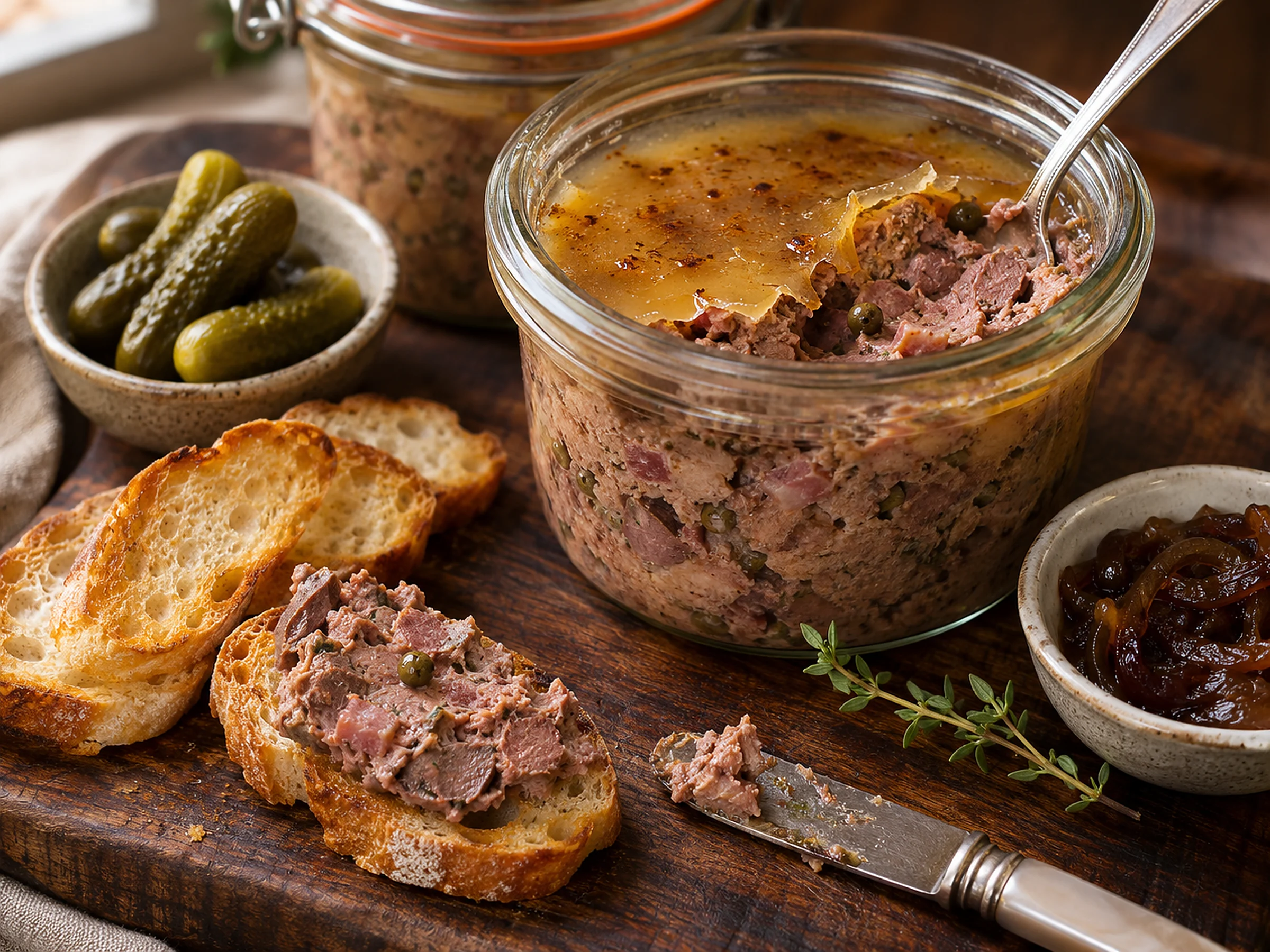
A wide glass jar of coarse chicken liver pâté with a golden brown-butter seal broken open by a spoon, flecked with green peppercorns and bacon, on a dark timber board with crisp toasts, one spread thickly, a bowl of cornichons, a dish of caramelised onion, a sprig of thyme and a second jar behind
Prep20min
Cook45min
All up

1hr 5min+ 18–24 hours

Serves12
LevelMedium

Mise en place

What you need

Tick each one off as it goes in.

The livers

The bacon and aromatics

The cognac

The butter

To finish

The board

Makes 12 serves

Last Christmas I made a chicken liver pâté with a good slug of cognac in it, and we took it to our Airbnb in Sandy Bay in Hobart for the staff Christmas party. It went down a treat. I never wrote it down, so this is the rebuild. Rustic, coarse, and properly boozy.

It went through the full AI competition: Claude, Grok, Codex and Gemini, four rounds, blind. The first thing all four said was the livers. Seared and pink in the middle is the usual way, and it's how pâté makes people sick: chicken livers can carry Campylobacter inside, so a sear doesn't fix it. Here they're seared for colour, then finished gently under a lid until the probe reads 70°C, and held there for two minutes. They come out creamy, maybe a blush of pink. Grey and sandy means they went too far.

The rest is about putting the flavour where you eat it. No flambé: half the cognac is boiled down in the pan, and 30 ml goes in raw at the end, which is the boozy bit. The brown butter goes into the pâté, not just on the lid. Most of it is pulsed coarse, and a small pile of liver is chopped by hand and folded through with soft smoked bacon and green peppercorns. The final was 3–1. Their predictions land between about 8.2 and 8.7 out of 10. It hasn't been cooked in this exact form yet.

Make it the day before, and eat it within three days. It has raw cognac in it, and Australian advice is that anyone pregnant shouldn't eat pâté at all.

Some stuff about it that's actually true. We checked.

Pâté started out as a pie. The word shares its root with pâte, pastry, and the early ones were baked in a crust. By the 1800s the pastry was often left off.

Setting cognac on fire doesn't burn the alcohol off. The USDA's own tables say about 75% is still there after a flambé. What the flame burns is the smell.

Green peppercorns are the same berry as black pepper, picked unripe and kept green, in brine or dried.

And Cognac has a deadline. Under the appellation rules, a year's wine has to be distilled by 31 March the following year.

AI reviewed by Grok, Codex & Claude
The method

Fifteen moves.

  1. Livers, Trim

    Cut out the sinew and every green, bile-stained bit. That's the bitterness, not blood, so don't soak them in milk. Cut the lobes so they're all about 2 cm thick and keep the small ones separate. Pat them dry. Wash the board and knife before anything else touches them.

  2. Butter, Brown

    90 g butter in a pale pan until the solids are deep hazelnut and it smells nutty. Not black. Into a jug straight away. Stir it, and spoon 30 g with plenty of the brown bits into a bowl for the pâté. Let the rest settle. The clear fat on top, about 40 g, is the seal.

  3. Bacon, Render

    Medium-low, 7–9 minutes, until the fat's run and the edges are golden but it's still soft. Not crisp: crisp bacon goes leathery in the fridge. Out. Leave 1 tbsp fat in the pan.

  4. Shallots, Soften

    Shallot and bay in the fat, gently, about 7 minutes, until soft and sweet with no colour. Garlic and thyme for the last minute. Scrape it all into a bowl. It comes out now so it doesn't burn when the livers go in.

  5. Livers, Sear

    4 g salt on the livers. Stainless pan, medium-high. Two batches, not crowded, 45–60 seconds a side, for colour only. They're still raw inside. Onto a clean tray.

  6. Livers, Hold

    All the livers and the shallots back in, 30 ml water, lid on, lowest heat. Turn them every 30–45 seconds. Probe three or four of the thickest pieces. When the coolest one hits 70°C, hold them at 70°C or a touch over for 2 full minutes, sliding the pan on and off the flame. Aim for 70–72°C. Pieces that have done their two minutes come out as they finish, before they pass 74°C. A blush of pink is fine. Bloody is not.

  7. Cognac, Reduce

    Livers and shallots onto a clean tray. Bay out. Pan off the flame, 55 ml cognac in. Back on, scrape, and boil it down with the juices to about 2 tablespoons of glossy syrup. No flambé. Over the livers.

  8. Livers, Cool

    Spread them out on the tray, 10–15 minutes, until just warm, about 40–45°C. Hot liver melts the butter and the jars weep.

  9. Pâté, Pulse

    Take out 90 g of the liver and chop it by hand to 3–4 mm. The rest into the processor with the shallots, the syrup, the 120 g soft butter, the 30 g brown butter and its bits, the 30 ml raw cognac, 1.5 g salt and the pepper. Pulse in one-second bursts, scraping once, 8–12 pulses, until it holds together with flecks you can see. Not smooth. You can't pulse it back.

  10. Bacon, Peppercorns, Fold

    Crush two-thirds of the peppercorns lightly, leave the rest whole. Fold the chopped liver, the bacon and all the peppercorns through.

  11. Salt, Test

    A teaspoon on a cold saucer, 10 minutes in the fridge. Taste it on toast. It should be a bit assertive on salt and plainly cognac, not hot. Up to 1 g more salt only if it needs it.

  12. Jars, Chill

    Pack into three clean 300 ml jars, pressing out the air. Stand them in iced water up to the shoulders, 15–20 minutes, then into the fridge, spaced apart.

  13. Butter, Seal

    When the pâté's cold and firm, warm the clear brown-butter fat just until it runs. A thin layer over each jar, right to the glass. Set, then lids on.

  14. Pâté, Rest

    Fridge, 18–24 hours. Keep it at 5°C or colder and eat it within 3 days.

  15. Board, Serve

    Take one jar out 15–20 minutes before you eat it so it spreads and the cognac opens up. Keep the others cold. Cornichons, crisp toast, and the onion if you want something sweet. To take it to a party, carry it upright in an esky with ice bricks and put out one jar at a time. Time out of the fridge adds up: under 2 hours it can go back in, 2 to 4 hours it gets eaten, after 4 hours it goes in the bin.

If it goes wrong

How to save it

The livers are grey and sandy
They went past 74°C. Can't be undone. Next time, uniform pieces and pull each one when its two minutes are up.
The jars have gone greasy or weeping
The livers were too hot when the butter went in. Can't be fixed in the jar; next time cool them to just warm first.
It's turned smooth like a parfait
Over-pulsed. Can't go back. Fold in a little more hand-chopped liver if you have any, and call it smooth.
The brown butter tastes bitter
It went black. Throw it out and brown a fresh lot before it goes near the pâté.
It tastes flat once cold
Under-salted. Soften it, fold in a pinch more salt, re-pack and re-seal.
It tastes hot and boozy
The cognac was rough or it's straight from the fridge. Let it come up 20 minutes. Next time a better VS.

Keep wandering

From the same volume.

Boozy Chicken Liver Pâtéserves 12 · 1 hr 5 min + 18–24 hours